

In Italia i boschi crescono il doppio di quanto vengono utilizzati: un’opportunità che può fare del legno la chiave della decarbonizzazione dell’edilizia.


In Italy, forests grow twice as fast as they are harvested, while the Italian construction sector, like the rest of the Italian wood supply chain, continues to import most of the timber it uses. This is a paradox that weighs on the Italian bioeconomy, but it also hides an enormous opportunity: if managed better, the forest supply chain could become a pillar of the decarbonisation of the entire Italian economy, thanks in particular to the role wood can play in the construction sector, supported by policies such as carbon farming and the new Piano Casa (Housing Plan).
What is sustainable construction
Sustainable construction refers to the set of design, building and management practices aimed at minimising environmental impact, from raw material extraction to the building’s end of life. It includes energy efficiency, the choice of low-impact materials, and indoor environmental quality.
There is, however, a less discussed aspect: sustainable construction can be, in every respect, one of the most concrete applications of the bioeconomy, meaning the use of renewable biological resources such as wood to produce materials, energy and services in place of fossil or carbon-intensive resources.
Wood is one of the materials that best embodies this principle: it comes from a renewable resource, regenerates over time through forest management, and at the end of its life cycle can be reused, recycled or recovered for energy purposes, following the so-called cascading use approach.
Why buildings are decisive for decarbonisation
The construction sector is not a side issue in the fight against climate change: the construction and use of buildings account, on average, for 35-40% of greenhouse gas emissions at the European level. This is one of the reasons why the European Union aims for a 55% reduction in emissions by 2030 and climate neutrality by 2050.
To achieve these goals, the construction sector must necessarily transform from a source of emissions into a possible carbon storage tool. Already in 2020, the President of the European Commission had pointed to the need for this transformation, stressing how the construction sector could become a true carbon sink rather than a source of CO2. Wood is the material that makes this paradigm shift possible, supported by specific European initiatives such as the Renovation Wave Strategy and the New European Bauhaus, discussed further below.
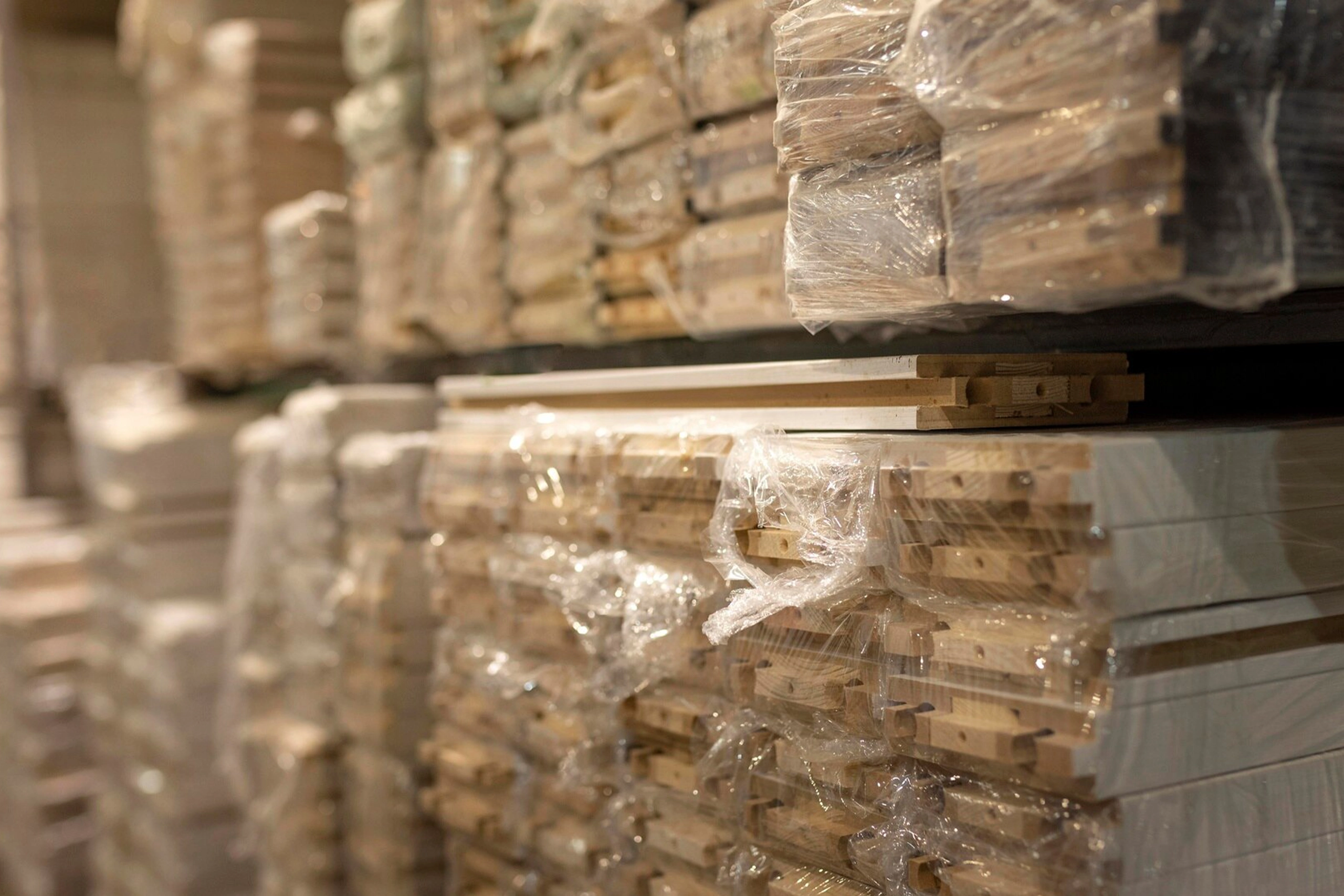
The dual role of wood: CO2 storage and substitution of carbon-intensive materials
Construction wood plays a dual function: on one hand, it stores the carbon absorbed by trees during growth, keeping it locked in for the entire useful life of the building. On the other hand, it replaces emission-intensive materials such as steel, concrete and bricks, avoiding the emissions linked to their production.
According to research published in Developments in the Built Environment, replacing conventional building materials with structural wood can reduce construction-phase emissions by up to 69%, equivalent on average to 216 kg less CO2-equivalent per square metre of usable floor area (Himes and Busby, 2020).
It is no surprise that, looking at the pyramid of building materials ranked by climate impact (Global Warming Potential), wood-based products occupy the lowest positions, compared with materials such as steel and concrete in the higher bands.
Italy’s forest bioeconomy: an underused potential
Why, then, does Italy not fully seize this opportunity? The answer lies in a paradox of the Italian forest bioeconomy: forests keep growing, but they are barely harvested, and the supply chain that should add value to them is weak upstream.
According to the study “Mapping and analysing wood flows across the Italian forest-based wood value chain” (Khan et al. 2026, published in the European Journal of Wood and Wood Products), Italy harvests only 33% of the forests’ annual increment (MAI, mean annual increment), against a European average of 66%.
Unlike the agricultural sector, where non-food biomass production competes directly with food crops, the forestry sector has ample room to grow without taking land away from food production: the National Forest Plan estimates that the harvest rate could rise to 40-45% of the annual increment while maintaining the forest carbon stock.
This underuse is reflected throughout the supply chain: the same study shows that almost 90% of the sawn timber, veneer and plywood consumed in Italy depends on imported wood, while recycling is already close to saturation (66.1% for panels, 57.1% for paper — Italy is the EU country that recycles the most in this segment).
The real lever for making construction genuinely sustainable, and a sector that stores carbon, must start from more active forest management, combined with a cascading use approach, which directs the highest-quality timber toward long-lasting structural uses such as construction, reserving residues for energy uses. For companies in the supply chain, understanding wood market trends is essential: Etifor carries out market and supply chain analyses for wood products to guide investment and development strategies.

Carbon farming and the CRCF regulation: is the wood supply chain ready?
Under the European regulatory framework, construction wood, thanks to its capacity to store carbon, can also generate carbon credits. Indeed, the European Carbon Removal and Carbon Farming regulation (CRCF, EU 2024/3012) recognises carbon storage in long-lived wood products such as timber structures for construction as an eligible activity for generating credits, provided the material remains in use for at least 35 years. Specific methodologies for the construction sector are expected by the end of 2026, with full operability from 2027.
Is the wood supply chain really ready for this regulation? A survey conducted as part of the WOOD4LIFE project, covering 156 Italian and Spanish companies, found that more than 75% report low or no knowledge of the content of the CRCF regulation. It is also worth noting that 70% of the companies surveyed do not highlight the role of wood in carbon storage in their marketing materials. However, existing forest certifications, such as FSC, are seen by more than half of the companies as a potential key tool for supporting the quantification and certification of carbon stored in wood products.
Policies for timber construction: New Bauhaus, Piano Casa and the measures still missing
At European level, several initiatives support sustainable construction. The New European Bauhaus promotes the use of sustainable, local materials in built spaces, the Renovation Wave Strategy pushes for the energy renovation of the existing building stock, and the new European plan for affordable housing aims to make quality homes accessible, also opening space for timber construction solutions.
In Italy, Decree-Law No. 66 of 7 May 2026 established the new Piano Casa (Housing Plan), with funding of 10 billion euros to bring 100,000 affordable housing units to the market over the next ten years, through the redevelopment of public residential housing and extraordinary maintenance works.
To date, the new Piano Casa does not include a specific measure earmarking resources for those who build with wood — the same limitation already shown by earlier incentive schemes such as the 110% Superbonus, the Renovation Bonus and the Ecobonus, none of which specifically rewarded the use of low-impact materials. Introducing minimum environmental criteria oriented toward structural timber could instead make a real difference for the growth of the Italian forest bioeconomy.
Etifor’s role for the wood supply chain and sustainable construction
The shift from carbon-intensive construction to genuinely sustainable construction requires a solid wood supply chain, informed about regulations and able to engage with the market. Etifor supports companies along the supply chain with market analyses, impact assessments and advisory services on the opportunities linked to carbon farming and the CRCF regulation, turning regulatory constraints into competitive advantage.
If you want to understand how to position your company in this evolving scenario, discover our market and supply chain analysis services for wood products.