

Ecosystem Services (ES) are commonly defined as the benefits nature offers to people. In economic terms, many of these present themselves as externalities, that is, effects of an activity that have positive or negative repercussions on parties who had no decision-making role in it. Although recognized as having economic value, many ES lack a pricing system and therefore a market capable of creating strong incentives for their protection and increased provision; this in turn creates difficulties in estimating their economic value.
The importance of Payments for Ecosystem Services
For this reason, decision-making processes for the conservation and enhancement of ecosystems have seen growing attention toward activating a range of policies and economic instruments aimed at increasing the supply of ES. Beyond conventional economic instruments, such as incentives and tax breaks, new instruments are emerging, such as Payments for Ecosystem Services (PES). The goal of PES is therefore to stimulate the production of ecosystem services, turning them into genuine products that can be traded on the market.
Defining Payments for Ecosystem Services
Numerous definitions of PES exist. One of the most commonly used is the one developed by Wunder in 2005, later revised by the same author in 2015, which defines them as “voluntary agreements, conditional on agreed rules, between at least one provider (seller of the service) and at least one buyer (beneficiary of the service), in reference to a defined environmental service.”
Requirements for establishing a PES
For a PES to be established, 5 conditions must be met:
- identification of a well-defined ES to be traded;
- the presence of at least one buyer of the ES;
- the presence of at least one seller of the ES;
- the voluntary nature of the ES transaction;
- the conditionality of the payment, whereby the producer is obligated to actively act to ensure the continuity of the ES over time.
Difference between PES and quasi-PES
However, these 5 conditions are not always met, and PES schemes are often implemented within a mandatory regulatory framework: in these cases, since the voluntary requirement is missing, they are referred to as “quasi-PES.” In reality, quasi-PES represent the most common type, while pure PES are rather rare.
Benefits of Payments for Ecosystem Services
PES thus bring ES into a market context and become an opportunity for remuneration for public and private actors who maintain and/or improve natural ecosystems, enabling them to deliver ES that benefit the community. To date, PES schemes have been applied to various types of ecosystem services: from carbon sequestration, to the regulation and protection of water quality for drinking or irrigation use, to biodiversity protection, tourism and recreational activities, and soil protection from erosion. Below are a few examples.
An example of quasi-PES in Italy
A significant but relatively underimplemented quasi-PES in Italy relates to the rules on drinking water consumption pricing established by the now-former Galli Law (Law 36/1994). These rules aim to compensate for the ES provided by the good management of catchment basins. To achieve this, the rules stipulate that a share of the tariff paid by drinking water consumers be transferred to the local authorities in whose territory the water abstraction points are located. In this way, authorities have the resources needed to carry out environmental protection and restoration measures. In this case, the rules provide for the beneficiary to pay directly for the ES consumed.
The Parco Fiume Brenta case study
Along these lines, a form of PES was developed and tested by Etifor within Parco Fiume Brenta. Parco Fiume Brenta is an initiative that has launched a virtuous path for safeguarding the water resource and the ecosystems connected to the middle course of the Brenta river, in Veneto. The project aims to establish an environmental fund for measures to mitigate and compensate for the negative impacts caused by the Integrated Water Service (Servizio Idrico Integrato, SII). The fund is financed by users through a small share of the water tariff.
Italian Legislation and the EU Water Framework Directive
The scheme underlying this system is the one proposed by Italian legislation (Ministerial Decree 39/2015 and ARERA Resolution 580/2019/R/idr) implementing the EU Water Framework Directive (WFD, 2000/60/EC). Specifically, Article 9, which establishes the “polluter/user pays” principle, provides for the compensation of negative environmental impacts caused by the consumption of water resources by end users, while also introducing the issue of internalizing Environmental and Resource Costs (ERC). Being easily replicable, the PES developed in the middle Brenta area represents a pioneering case for other basins interested in developing this mechanism.

Another example: WOWnature
Another particular form of PES has been developed by Etifor through WOWnature. WOWnature is a platform that allows citizens, companies and associations to become stewards of the forests and woodlands around us that provide the ecosystem services we benefit from every day. Through the WOWnature platform, companies and citizens can support reforestation projects (by adopting a tree) or the protection of existing forests, thereby contributing to the growth and conservation of the benefits these ecosystems naturally provide. The goal is to create a relationship of mutual support and active participation among public administrations, companies and citizens to care for an asset of immense value, especially in light of the environmental challenges we are facing in this era. All WOWnature projects follow the principles of good forest management, understood as increasing the naturalness and biodiversity of the intervention areas, and ensure that forests are managed in compliance with the environmental, social and economic standards certified by the Forest Stewardship Council.
The LIFE ProForPES project: guidelines for integrating PES into European funding
While WOWnature and the Parco Fiume Brenta case show how PES can be activated at the local level, a broader question remains open: how can these mechanisms be integrated into the European Union’s major funding programmes? This is the central question behind LIFE ProForPES, a European project in which Etifor is a partner alongside the University of Padova, the European Forest Institute, the Hochschule für Nachhaltige Entwicklung Eberswalde and the Universität für Bodenkultur Wien.
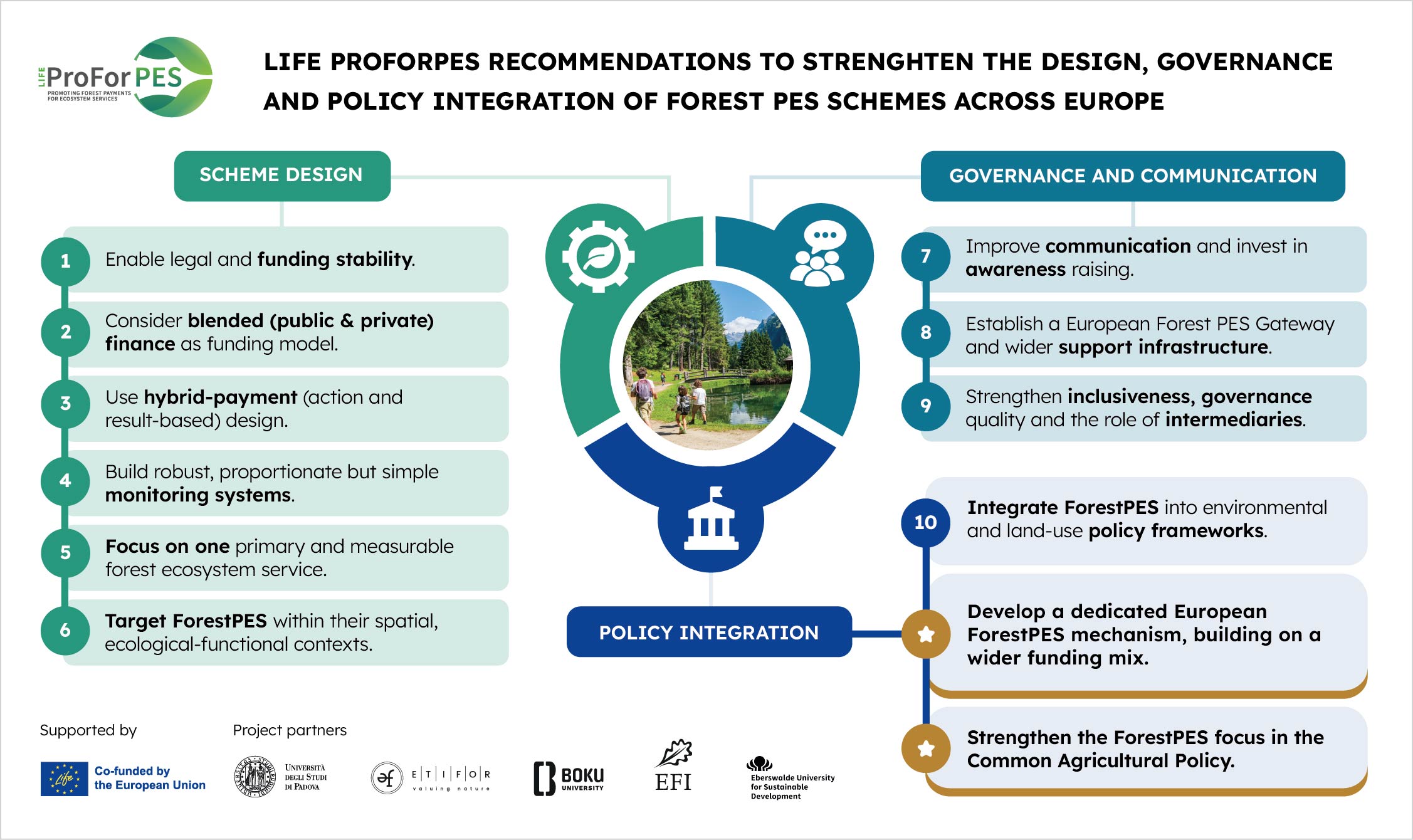
The project recently published the document “Guidelines and recommendations on incorporating PES in EU-supported financial programmes”, which proposes 7 application scenarios for forest PES — from biodiversity payments through the Common Agricultural Policy, to the protection of drinking water reservoirs through utility-led schemes, to certified forest carbon removal in line with the Carbon Removal Certification Framework (CRCF) — and 12 policy recommendations to strengthen the integration of PES into EU financial frameworks.
Among the main findings to emerge from consultation with over 60 European stakeholders: favouring hybrid payment models (one component linked to actions undertaken, one to verified results), focusing on blended public-private finance, and aligning monitoring systems with existing reporting obligations (such as the Water Framework Directive or the Nature Restoration Regulation) to keep transaction costs down. The project also proposes the establishment of a European Forest PES Gateway, a shared platform for exchanging contractual models, indicators and case studies across Europe.
Etifor’s role in Payments for Ecosystem Services
Activating PES mechanisms requires the appropriate involvement of all relevant actors and careful consideration of the 5 steps outlined above, both from a technical standpoint and in terms of resource governance. While not an entirely new idea in the context of environmental policy, it has experienced — and continues to experience — a period of great activity, with numerous theoretical and methodological studies and case studies carried out only in recent years. As a result, there is growing confidence that leads to viewing these initiatives as tools with great potential for the remuneration of ES.
Etifor has built extensive experience in this field and supports public and private bodies interested in enhancing the value of their natural resources through this type of mechanism. Discover our GRAN approach to enhancing the value of the resources and natural areas of your territory.