
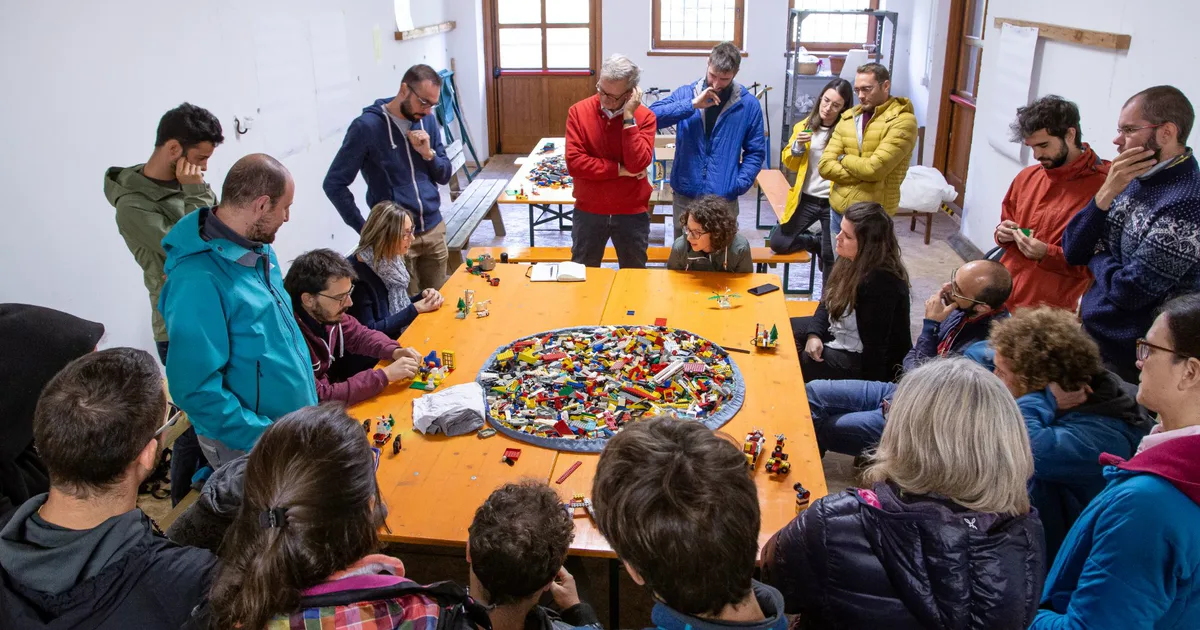
Facilitation is the work of guiding a group of people towards a shared goal, taking care of the process while leaving the merit of the decisions to the participants. In projects involving forests, rivers, protected areas and tourist destinations, it is what turns a simple public meeting into a participatory process capable of producing shared choices.
This article explains what facilitation is, what the levels of participatory processes are and how to design a process that does not remain a formal exercise.
Key takeaways
- Facilitation guides a group towards a defined, shared goal: the facilitator safeguards the process, while the content stays with the people involved and the technical team.
- A meta-analysis of 305 cases in 22 Western democracies shows that participation improves the environmental quality of decisions. The most stable factor is the delegation of power to participants (Newig et al., 2023).
- Participatory processes have four levels of intensity: inform, consult, co-design, empower, in line with the IAP2 Spectrum of Public Participation. Each level carries a participatory promise, to be made clear from the start: choosing it honestly is the first decision to take.
- A participatory process is valid at every level, as long as the participatory promise is clear. The higher the level, the more open the decision must still be: if it has already been taken, the honest option is to limit yourself to informing or to consulting on what can still change.
- In environmental projects, facilitation works best when paired with technical expertise: process and content remain distinct, but work together.
What is facilitation and what are the tasks of a facilitator
Facilitation is an approach to guide a group of people towards a defined, shared goal, structuring the discussion so that every voice can contribute. The facilitator safeguards the process, not the content: they design the process, manage time and dynamics, protect a safe working space and do not steer the conclusions.
This neutrality is what distinguishes facilitation from moderating a debate or from technical consulting. The facilitator does not bring their own solution. They create the conditions for the group to build one, even when the starting points are far apart.
The main tasks of a facilitator are to:
- design the process with the client, clarifying objectives, the people to involve and the room for decision;
- choose techniques and formats suited to the purpose, the context and the group;
- lead the meetings, alternating moments of opening up ideas and moments of synthesis;
- manage group dynamics and conflicts, making power relations visible to give space also to the voices that are heard less;
- report results back to the people involved, in a transparent and verifiable way.
What are participatory processes (and why they matter in environmental projects)
Participatory processes are structured, time-limited pathways through which public bodies, companies or partnerships involve citizens and stakeholders in a decision that affects them. In environmental and territorial projects they help build stronger choices on common resources such as water, forests, landscape and tourism.
Decisions on a river basin or a protected area affect many actors with different interests: municipalities, farms, service providers, associations, residents. Involving them with a clear method helps bring out local knowledge, prevent conflicts and make choices more widely accepted over time. Facilitation is the tool that makes this dialogue possible.
What research says about the effectiveness of participation
Scientific evidence confirms the value of participation, but with a precise condition. Newig’s research group analysed 305 cases of public environmental decisions in 22 Western democracies. Participation improves the environmental quality of plans, agreements and permits, and the most stable factor is the delegation of decision-making power to participants (Global Environmental Change, 2023).
An earlier study on the same database of 305 cases adds a useful detail. The positive effect is stronger when communication within the group is intense and when decision-making power is truly shared. Two factors act as a bridge: the convergence between stakeholders’ points of view and the strengthening of their capacities (Jager et al., JPART, 2020). In other words, a process is not valued for the number of meetings, but for how real the dialogue is.
These results do not apply only to the delegation of power. A literature review distinguishes engagement from simple communication up to co-production and shows that the outcome depends above all on process design and context (Reed et al., Restoration Ecology, 2018).
The rules that require participation
Participation is increasingly a requirement, not a choice. The Aarhus Convention, to which the European Union and all its 27 Member States are Parties, recognises the right of the public to take part in environmental decisions (European Commission). The Water Framework Directive provides that the public must have at least six months to submit written comments on the draft river basin management plans (Directive 2000/60/EC, art. 14).
European research also goes in this direction. The EU Mission “A Soil Deal for Europe” aims to create 100 living labs and lighthouses by 2030. They are spaces where researchers, farms and communities test solutions for soil health together (Mission Soil Platform).
In Italy, the Public Procurement Code makes public debate mandatory for major works above certain cost thresholds.
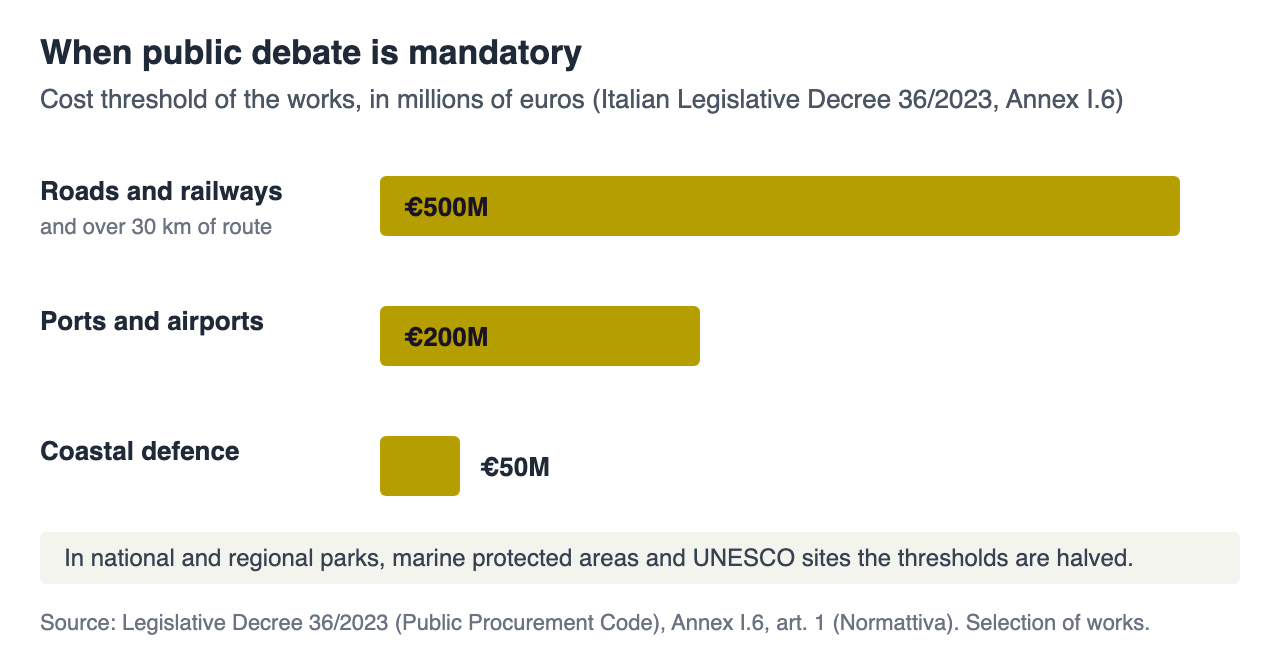
The thresholds are halved in parks, marine protected areas and UNESCO sites (Legislative Decree 36/2023 (Normattiva), Annex I.6). Some Regions have dedicated laws, such as Tuscany with Regional Law 46/2013 and Emilia-Romagna with Regional Law 15/2018. The 2025 participation call of Emilia-Romagna, for example, makes over 800,000 euros available for local processes (Emilia-Romagna Region).
What are the levels of participatory processes
The levels of participatory processes indicate how much decision-making power is shared with the people involved. There are four: inform, consult, co-design and empower. There is no absolute “best” level: there is the one that suits the objective, and it should be chosen together with the client before starting.
This framework is inspired by the IAP2 Spectrum of Public Participation, which distinguishes five levels: inform, consult, involve, collaborate and empower. Here, involve and collaborate correspond to co-design. Each level is associated with a participatory promise, that is, what is guaranteed to participants: from “we will keep you informed” to “we will implement what you decide”. The promise must be declared before starting.
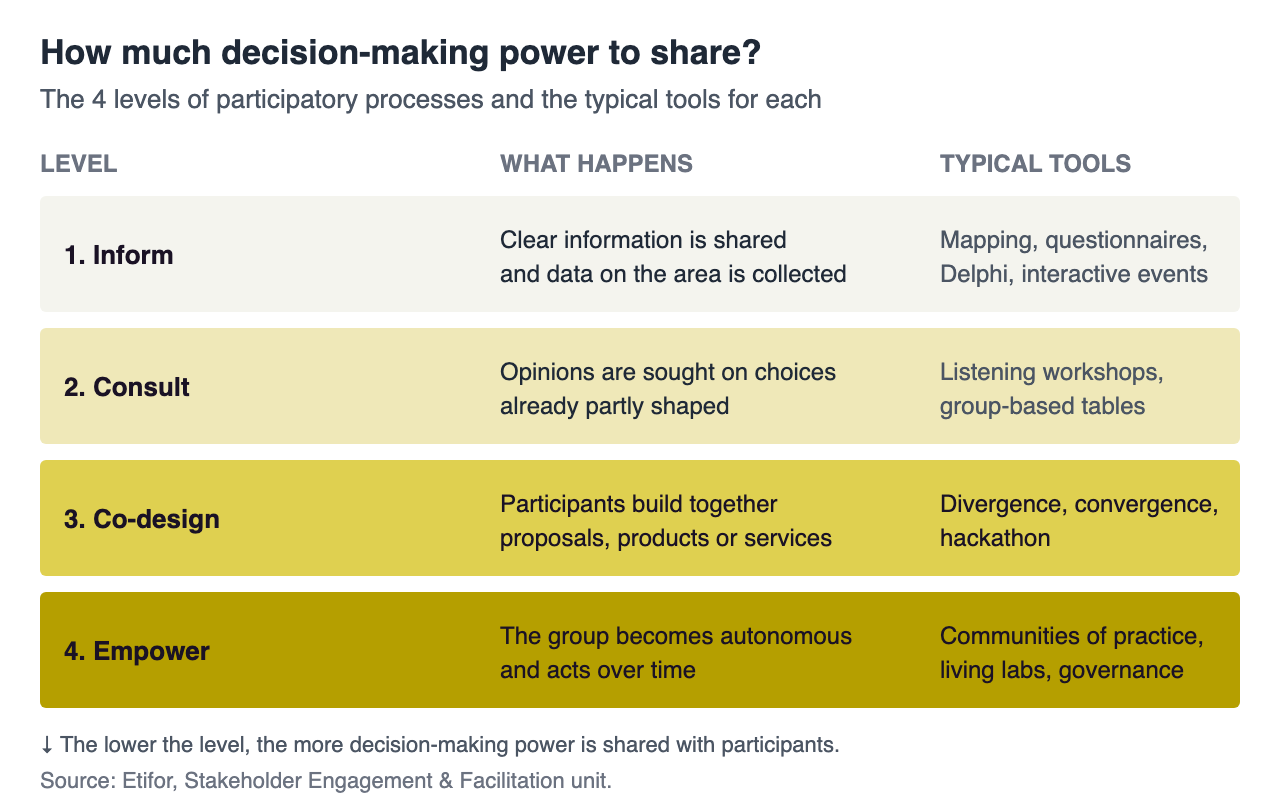
Inform. People receive clear information about a project or a decision, and whoever promotes it collects data and knowledge about the area. This includes stakeholder mapping, qualitative data collection through questionnaires, focus groups or the Delphi method, and interactive events.
Consult. Opinions are sought on choices that are already partly shaped, to improve or validate them. Listening workshops and group-based discussion tables are the typical tools. The final decision remains with whoever promotes the process, and this must be stated clearly from the start.
Co-design. The people involved build proposals, products or services together, through structured pathways of several meetings. Phases of divergence, in which ideas are opened up, alternate with phases of convergence, in which choices are made. Typical tools include hackathons and workshops based on design thinking.
Empower. The group becomes autonomous and able to act over time. This is the level of communities of practice, of the living labs that grow out of them, of shared governance systems and of common rules to manage a resource. It requires the longest pathways, but produces the most lasting effects.
When a participatory process is really needed
A participatory process is needed when there is a decision to build with different actors, even in conflict. It works at every level if the participatory promise is clear from the start, that is, if it is stated what can change and what cannot. The higher the level, the more open the decision must still be. If it has already been taken, the honest option is to limit yourself to informing or to consulting on what can still change, without presenting as co-design what is not.
“Participation” is a much-used and sometimes abused word. The danger is tokenistic participation: meetings in which people are listened to without the listening changing anything. The risk is real. It wears out stakeholders, burns trust and makes future processes harder. This is why the starting principle is to participate for a purpose, not just to participate.
Do you really need a participatory process? Five questions to find out
- Is the decision still open, at least in part?
- Does the outcome depend on the collaboration of different actors (public bodies, companies, communities)?
- Are there conflicts, or diverging interests, to bring out and manage?
- Is whoever promotes the process ready to take into account what will emerge?
- Are there time and resources to report the results back to those who took part?
If the answers are mostly “yes”, a facilitated process is the right path. If the “no” answers prevail, it is better to opt for clear information or a targeted consultation.
How to design a participatory process: the phases
A good participatory process is co-designed with the client and stays flexible: a single workshop can change shape several times depending on what emerges. The main phases follow a logic that starts from listening, goes through discussion and arrives at feedback.
- Clarify the real objective. An initial interview with the client defines what is to be achieved, how much influence participants will have and which constraints exist. This is when the level of participation is chosen.
- Map and analyse stakeholders. Categories of actors are identified together with the client and information is collected, also through word of mouth among contacts (snowball sampling). Then a priority ranking is built on shared criteria.
- Choose techniques and formats. Each objective requires different tools, in person, online or in hybrid form.
- Lead the meetings. The facilitator uses deep, generative questions, alternates divergence and convergence and ensures a space in which everyone can express themselves without role-related inhibitions.
- Report back and move to action. The results return to the people involved and turn into choices, plans or governance rules, with clear responsibilities.
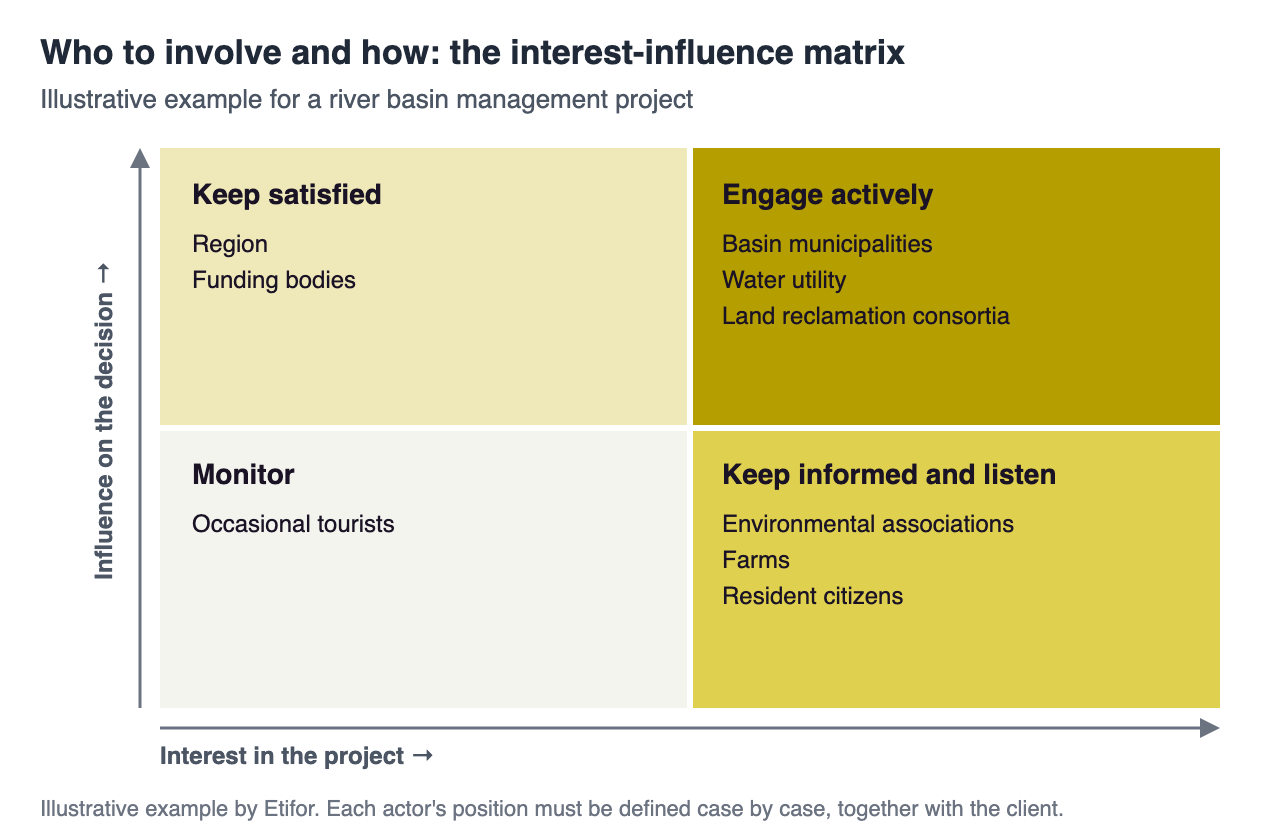
Stakeholder mapping is the basis of every process. A simple tool is the interest-influence matrix, which helps decide who to involve actively, who to keep informed and who to monitor. The position of each actor, however, must be defined case by case: no framework replaces knowledge of the territory.
A published example is the participatory mapping of European forest stakeholders carried out in the Horizon Europe project OptFORESTS. The work used the quadruple helix model, which considers research, institutions, businesses and civil society. It identified 45 stakeholder categories in three sub-communities: forest genetic resources, forest reproductive material and protected forests (Rogelja et al., Trees, Forests and People, 2025). The study is also co-authored by members of Etifor’s facilitation and research teams.
The most widely used facilitation techniques
Techniques are chosen based on the purpose, not by habit. Among the reference approaches are Theory U and design thinking, which guide the group from exploring the problem to prototyping solutions. Some recurring tools:
- World Café: small rotating tables that make ideas circulate across the whole group;
- Open Space Technology: the people present propose the topics and freely choose which tables to work at;
- Liberating Structures: micro-formats, such as 1-2-4-All, that give everyone a voice even in large groups;
- Focus groups and the Delphi method: to collect expert opinions or those of specific groups in a structured way;
- Future Search: to build a shared vision of the future of a territory.
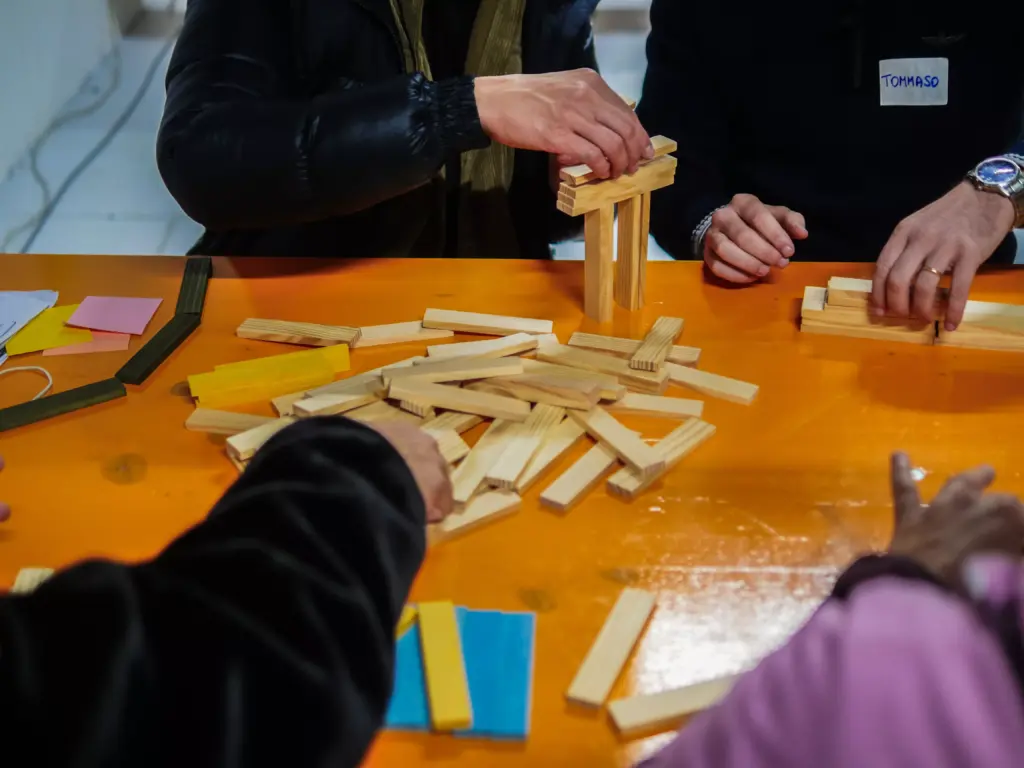
Icebreaking activities also have a precise function. They help people who do not know or trust each other to start collaborating before tackling the most delicate topics.
Facilitation and technical expertise: the process + content pairing
In environmental projects, facilitation works best when the facilitator works in pairing with the technical team. The facilitator safeguards the process, while those who work on forests, water or tourism safeguard the quality of the content. Each stays in their own role, and the group can focus on solutions.
This division of roles has a practical effect. Participants receive reliable technical information when needed, without the person leading the process becoming a party to it. At the same time, the technical team does not have to manage group dynamics, and can listen to local knowledge that often does not appear in the data.
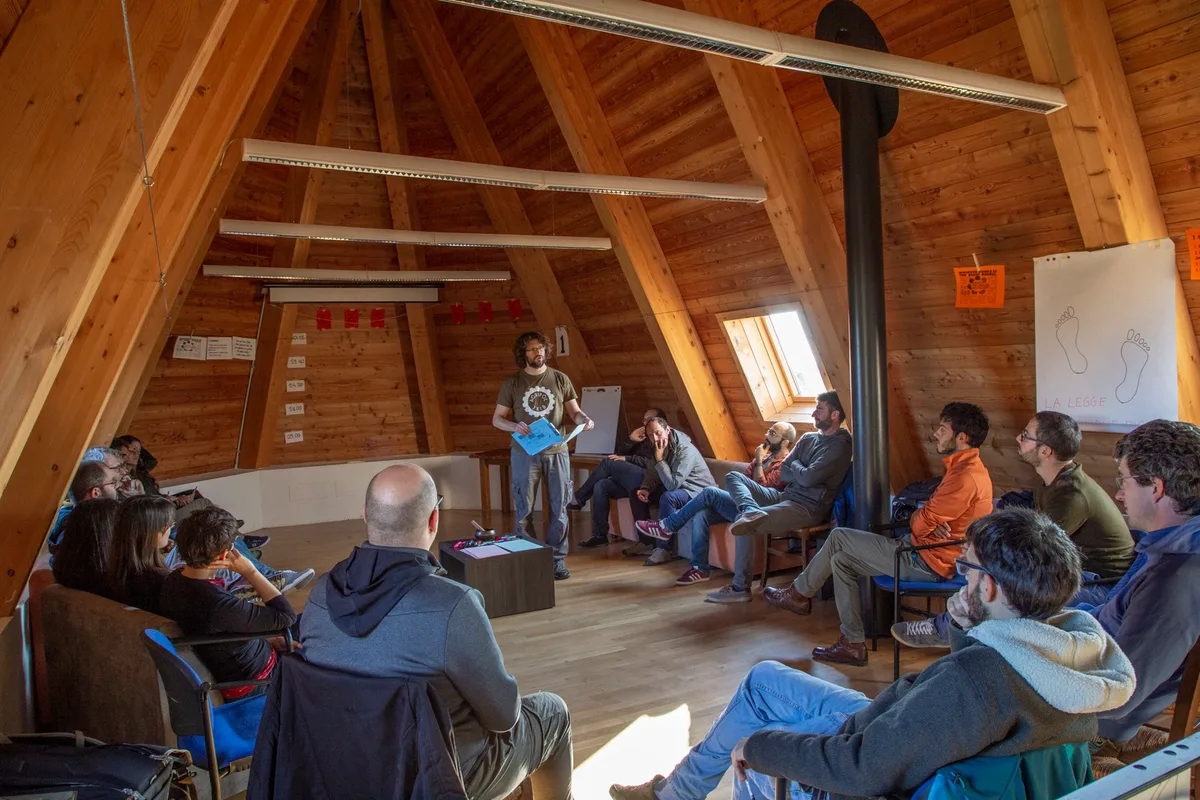
An example is the GSTC certification pathways for tourist destinations. The tourism technical team knows the standard: it builds the action plan, gathers input and answers questions on content. The facilitator, instead, manages the dynamics of the meetings, so that every group of actors can express itself.
Complexity, in these contexts, is not an obstacle to be reduced. More points of view mean richer decisions and a greater capacity to adapt to change rather than endure it. The task of facilitation is to move through it with method.
Examples of facilitated participatory processes
The examples below show how the different levels of participation translate into concrete formats, from consultation to shared governance.
Consult: GSTC certification in Trentino. Between 2022 and 2024 the A.T.A. Città, Laghi e Altipiani, with Trentino Marketing, followed the GSTC certification pathway. The pathway included participatory meetings divided by category: public bodies, businesses and associations. Each table analysed the strengths and weaknesses of the destination against the criteria of the standard.
Consult and co-design: the TRACCE local development strategy. Between January and August 2023 the GAL Alto Bellunese built its 2023-2027 strategy through a participatory pathway. The pathway included a survey of 1,050 residents, through telephone interviews and online questionnaires. A collection of project ideas and a series of meetings across Agordino, Longaronese-Zoldo and Cadore followed. The programme was approved in December 2023 with just over 6.4 million euros (GAL Alto Bellunese).
Co-design: the REGENERATE hackathon. In Val Saisera, in Tarvisio, four teams from Italy and Austria worked for two days, supported by mentors, with facilitation techniques and design thinking. Four regenerative tourism proposals came out of it, for as many Alpine territories (REGENERATE hackathon).
Empower: the shared governance of the Medio Brenta. In the LIFE Brenta 2030 project (2019-2024), animation, consultation and training activities involved 15 municipalities in a new governance model. The result was the first case in Italy of delegating the management of a Natura 2000 site to a Basin Council. One million euros of mitigation measures also entered the Water District Plan.
The same logic also applies at European scale. For the European Commission (DG AGRI), Etifor’s facilitation team co-designed and led four events of the EIP-AGRI partnership. Topics included circular water management and animal welfare.
How Etifor facilitates participatory processes
At Etifor we believe that decisions about nature work better when they are built together. Our Manifesto says it simply: “We co-create projects and services using participatory techniques in continuous dialogue, internally and with our partners” (Culture Manifesto).
The facilitation team works alongside our technical teams, from the local to the international level, in Italian, English and Spanish. We support public bodies, companies and European partnerships in stakeholder mapping, in consultation and co-design pathways and in building governance models for protected areas.
For public bodies, destinations and European partnerships that are designing a participatory process, we can help choose the right level and build it together.
Frequently asked questions about facilitation and participatory processes
What is group facilitation?
It is an approach to help a group of people work together towards a shared goal. The facilitator structures the discussion, manages the dynamics and stays neutral on the substance, so that decisions truly belong to the group.
What is the difference between consultation and co-design?
In consultation the decision is already partly shaped and opinions are collected to improve or validate it. In co-design the people involved build the proposal together and share a real part of the decision-making power.
How long does a participatory process last?
It depends on the level of participation and on the objective. An information event can last a few hours, a consultation a few weeks. Co-design and shared governance pathways can take months or years.
Do you need an external facilitator?
It is advisable when whoever promotes the process is also a party to it, or when there are conflicting interests. An external facilitator guarantees neutrality and allows everyone, including the client, to focus on the content.
What are participatory governance processes?
They are pathways that build, over time, rules, agreements and shared responsibilities to manage a common resource, such as a river or a protected area. They correspond to the highest level of participation, empowerment. An example is the governance model of the Medio Brenta that emerged from LIFE Brenta 2030.
What is the role of communication in participatory processes?
Communication clarifies from the start the boundaries of the process, that is, what can be decided and what cannot, and reports the results back to those who took part. Without transparent feedback, even a good process loses credibility.
Why should administrations develop skills in participatory processes?
Because regulations increasingly require it, from the Aarhus Convention to public debate on major works, up to the nature restoration plans. And because well-designed processes improve the quality of environmental decisions and make them easier to accept.
